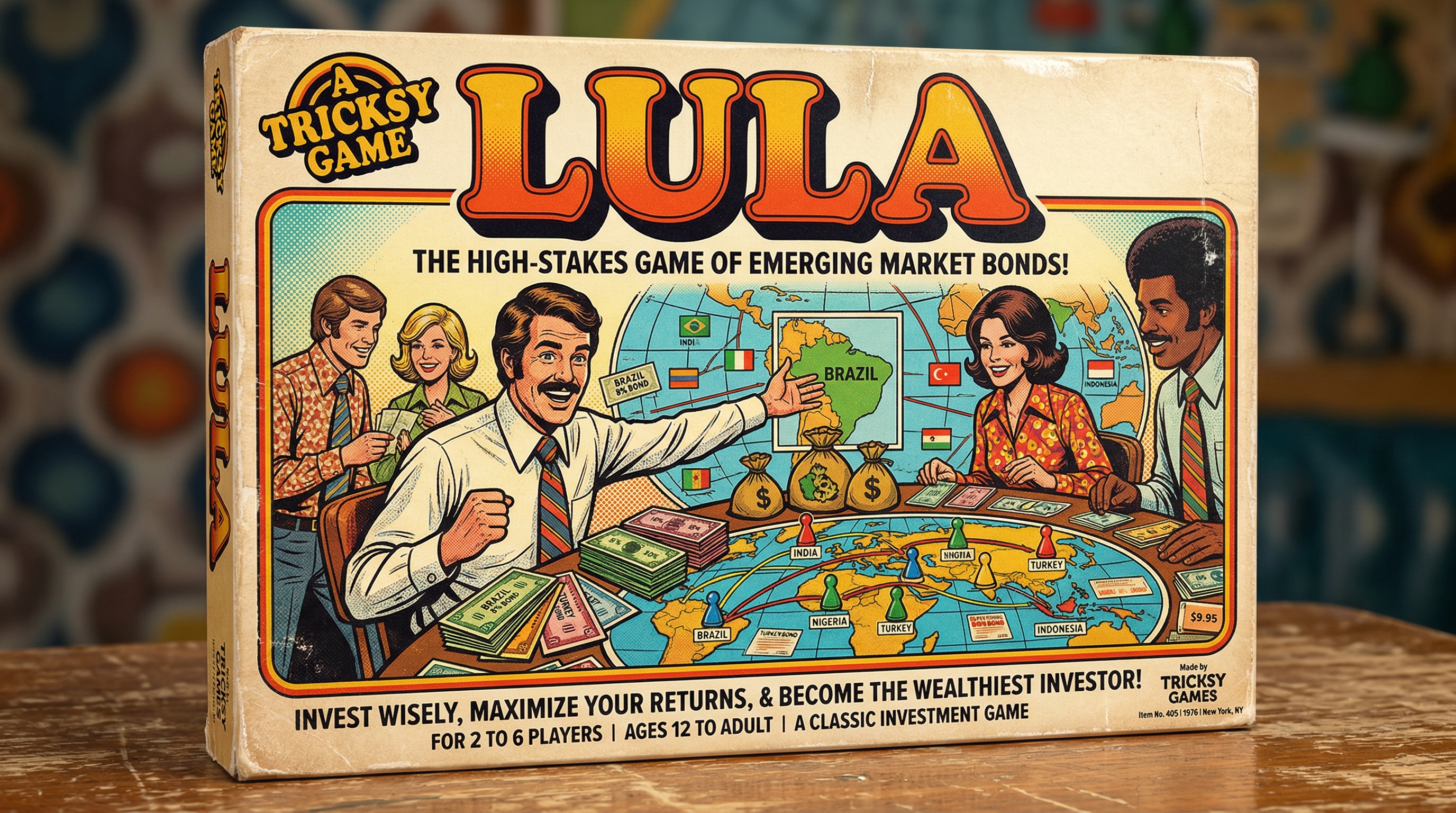
Lula was a classic board game from the 1970s, much loved (and sometimes hated!) by all the family. We're thrilled to bring it back to life in 2026 for today's tech-savvy generation.
Click to open the box
LULA
Sovereign Debt Trading Simulation
Economic engine based on Bassa & Cont (2025) — "Dynamics of Sovereign Debt"
You manage a $100M emerging-market sovereign bond fund.
Each turn = 1 quarter. Allocate capital across 4 sovereign issuers.
Each country has a default probability — the chance it fails to pay its debts this quarter. Low (<1%) means safe; rising (1-10%) means trouble; high (>10%) means get out.
Fund costs: 2%/year (trading, custody, liquidity).
Win: $200M | Lose: >40% drawdown or all 4 default.
Default Probability Model
KEY CONCEPTS
Default Probability
The chance a country fails to pay its debts this quarter. This is your most important signal: low (<1%) is safe, 1-10% is trouble, >10% means danger.
Spread
The extra yield (in basis points) a country pays over the risk-free rate. Higher spread = higher return but higher risk.
Credit Rating (IG / HY)
Investment Grade (IG) = safer. High Yield (HY) = riskier. A downgrade from IG to HY triggers credit rationing in the Bassa-Cont model.
Regime (Green / Yellow / Red)
Green = stable, Yellow = stressed, Red = crisis.
Fiscal Policy (BAU / Austerity)
Governments switch to austerity when debt gets dangerous — cutting spending to stabilise debt.